Additionally, this project also turned into a proof-of-concept for the future development work at Infodation: With AI aid, we were able to shorten the time between idea and demo-able first version of the product to two weeks.
Old assumptions
Customer service calls are more than exchanges of information; they are emotional journeys. Customers enter conversations with expectations, frustration, or urgency. Agents respond under constant time pressure, often while juggling multiple systems at once. Sentiment is traditionally measured after the call.
The Research Question
We wanted to explore if AI can reveal the subtext during a customer interaction and how that understanding can be turned into better service. The core question behind our AI research was simple but ambitious: can we understand the quality of these interactions as they unfold, not after they end?
The Experiment
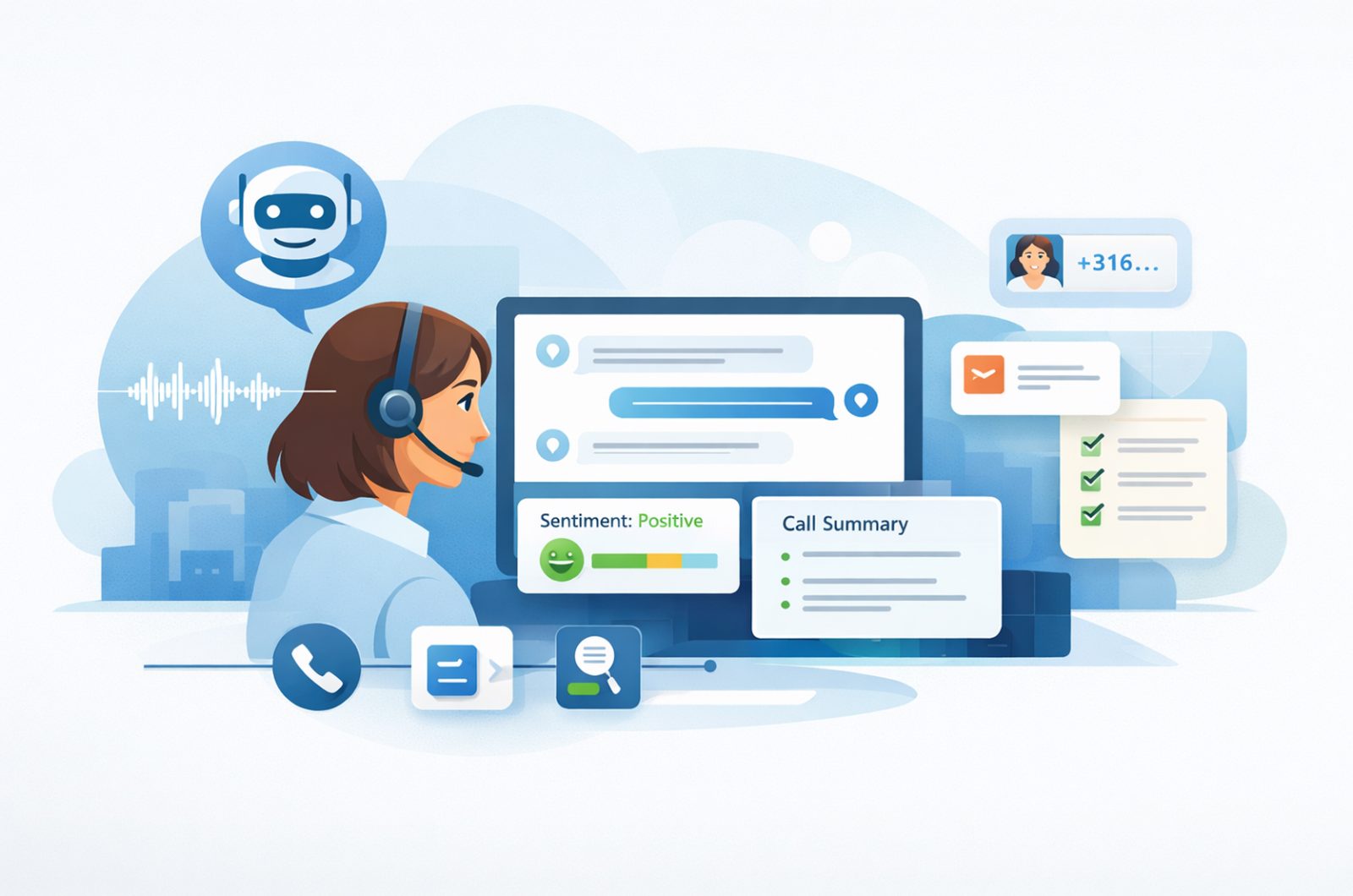
To answer this question, we built a proof of concept designed to make call centers more effective by supporting agents in real time. For the Smart Calling Center, we adopted a no-code/low-code approach: the backend was built using n8n and Azure Communication Services (ACS) APIs, while the frontend was developed with Lovable and Cursor AI, powered by Vite. The POC combined several AI-driven capabilities, including:
- Live call transcripts
- A real-time customer information panel
- Phone number recognition and extraction
- AI-generated case summaries
Together, these features provided agents with immediate context, clarity, and support. Without disrupting their workflow.
What the AI Revealed
Three insights stood out clearly.
- Real-time sentiment tracking
Analyzing sentiment during live calls showed that both customer and agent emotions can change rapidly. Making these shifts visible helps agents adjust their tone and approach immediately, instead of reacting after the fact. - Separation of voice and chat
Separating voice transcription from chat messages enables more accurate analysis. Voice captures tone, emotion, and urgency, while chat provides precise content. Combined, they offer a richer and more reliable understanding of the interaction. - Auto-generated summaries
AI can generate high-quality summaries from entire conversations. This significantly reduces documentation time while improving accuracy and consistency.
What This Means for Our Work
These insights highlight how AI can improve both service quality and operational efficiency.
- Improved service quality: Real-time sentiment analysis helps agents detect dissatisfaction early and respond effectively.
- Increased efficiency: Auto-generated summaries free agents from administrative tasks, allowing them to focus on the customer.
- Data-driven insights: Combining voice, chat, and sentiment creates valuable data for training and continuous improvement.
- Seamless integration: Integration with CRM systems like HubSpot or Salesforce ensures information is updated automatically, reducing manual effort.
New Assumptions
This experiment challenges how we think about AI in customer service. In a way, technology can enable empathy. AI does not replace human agents. It only helps them understand customers better and respond more effectively. Real-time insight proves more valuable than post-call analysis, because it enables immediate action when it matters most.
It also challenges familiar habits:
- Summaries can only be written manually
AI can generate high-quality summaries at scale. - Voice and chat are separate channels
Together they provide a fuller picture. - Sentiment can only be measured after the call
Real-time analysis enables timely intervention.
Listening beyond words
This experiment shows how a pragmatic, experiment-driven AI strategy leads to real results. By using AI to support human agents in real time, we demonstrated both speed (from idea to POC in two weeks) and impact. AI helps human support agents work faster, stay focused, and deliver better customer experiences.


