Orders stall between systems
Intake, validation, and provisioning are not connected tightly enough, so teams keep stepping in manually.
When order logic, legacy systems, and network processes all collide, speed and predictability disappear. We build the system layer that turns intake, validation, provisioning, and exceptions back into one workable flow.
The problem is rarely one system on its own. Friction builds between CRM, portals, provisioning, billing, and back office, exactly where speed and accuracy matter most.
Intake, validation, and provisioning are not connected tightly enough, so teams keep stepping in manually.
New propositions and change flows still need to work around old rules without disrupting operations.
Changes in contracts, addresses, products, or connections create too many handoffs.
One missed validation or wrong route immediately affects delivery, billing, and customer experience.
Not by adding another tool, but by improving the process layer where decisions, checks, and system transitions meet.
We connect intake, validation, provisioning, and feedback into one operational chain.
Rules and deviations belong in the system, not in tribal knowledge or ad hoc checks.
With dashboards and signalling, teams steer on backlog, deviations, and lead time instead of gut feel.
Always tied to an operational bottleneck that shows up directly in speed, error risk, or customer impact.
For processes where multiple systems each hold part of the truth, but no one controls the whole flow.
For teams losing too much time to change, check, revert, and reprocess work.
For environments where classification, routing, and prioritisation need to move faster without putting more pressure on operations.
Better systems architecture pays off quickly in telecom because delays and rework usually come from the same recurring bottlenecks.
Less rework, tighter control over the order flow, and faster delivery without quality taking the hit.
Telecom systems are critical infrastructure and fall under stricter security requirements such as NIS2. We make security part of how we build and maintain those systems.
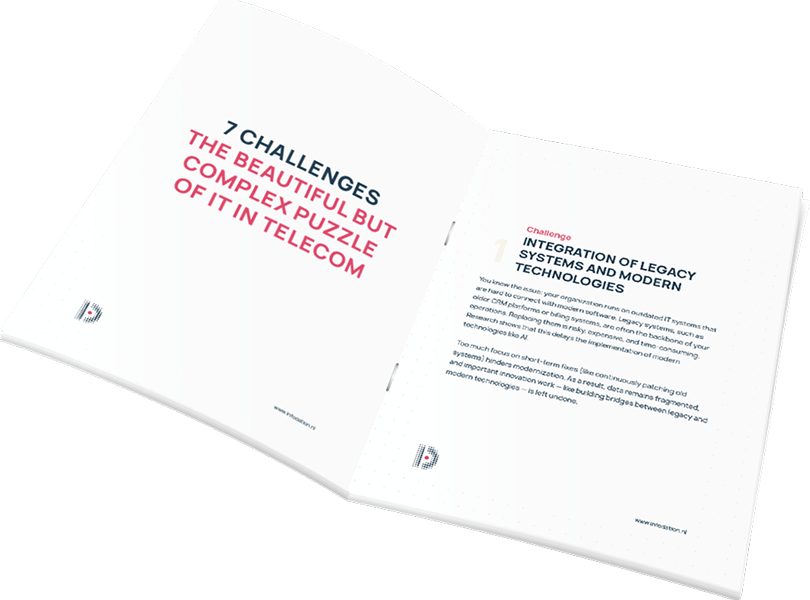
Are you responsible for software development and system integration in telecom? Then you’ve got quite a challenge on your hands. The Dutch telecom sector is in the midst of a radical digital transformation.
When choosing a software partner, you want to know exactly where you stand. That's why we answer three essential questions: about the balance between standard and customization, the cost of an implementation, and how we ensure cybersecurity. That way you know immediately what you can expect from us. Do you have any other questions? Then get in touch!
Show us where orders stall, where changes create too much manual work, or where provisioning has become fragile. We can quickly point out where a better system approach will make the difference.