IntelliCall
Transitioning to an AI-Driven Call Center
- Works 24/7
- 100% accurate
- Answers in real time
- Can speak 45+ languages
Sabre asked us to completely rebuild the Vietnam Airlines call center
Sabre Red 360 is a modern, web based travel booking platform within the Vietnam Airlines ecosystem. The platform helps travel agents worldwide search, compare, and book flights, hotels, and car rentals. They gave us a blank canvas, so we developed IntelliCall: an AI driven customer interaction platform.
Try it out. Ask IntelliCall questions that are accurate for airline customers. The demo starts in Vietnamese, but you can ask to speak in Dutch or English.
Sabre's Request
Vietnam Airlines (VNA) operates in an environment where customer interaction is critical to both service delivery and commercial growth. Previously, the organization relied on a traditional call center with a classic IVR structure, guiding customers through menu-based options while handling interactions largely manually.
As the company moved toward innovation, there was a clear need to demonstrate a next-generation, AI-driven customer interaction model in a tangible and compelling way. So Sabre engaged Infodation and gave us an opportunity to build everything from scratch.
What started as a proposal quickly became something much bigger. The first working version immediately surprised the client. Without explicitly being requested, the system was already capable of handling multilingual conversations, including Chinese, and scaling to over 45 languages.
It became clear early on: this is not just a solution for one airline. Any organization operating a call center can leverage IntelliCall.
From Static IVR to Intelligent Conversations
The existing system lacked flexibility and no longer met modern customer expectations. Interactions were static, impersonal, and difficult to scale. At the same time, there was no effective way to showcase how an AI-powered call center would function in practice. This created a dual challenge: building an innovative solution while also making that solution immediately understandable and experienceable for stakeholders.
Limited flexibility
IVR structures offer fixed navigation trees. Customers who fall outside the menu get stuck — leading to frustration and abandoned calls.
Impersonal interactions
Traditional systems recognize no context, tone, or intent. Every interaction starts from scratch, with no sense of continuity or understanding.
Poor scalability
Manual handling scales linearly with volume: more calls means more agents. There was no intelligent layer to absorb load during peaks.
AI hard to demonstrate
Stakeholders understood AI was theoretically possible but had no working reference. The gap between concept and execution was tangible and blocking.
Technical and experiential
The challenge was not only technical. Building a working solution and making the experience compelling and approachable for decision-makers was equally complex.
IntelliCall
The approach deliberately combined technology with user experience. Instead of presenting a conceptual model, an interactive web application was developed to serve as a central hub for AI-driven communication. The strategy focused on using real-time voice AI as the primary interface, enhanced by function calling that allows the AI to take action within the application and beyond. The IntelliCall project aimed to deliver a functional and scalable AI call center concept within a short timeframe.
Enabling real-time voice interaction
The AI responds immediately and holds a dynamic conversation that adapts to the customer and their context. No fixed scripts, no hold menus.
Integrating multiple communication channels
IntelliCall combines web interface, PSTN telephony, and AI voice in a single platform — supporting 45+ languages including Vietnamese, Chinese, and Dutch.
Creating a seamless customer journey from initial contact to action
Users are actively guided toward relevant next steps, such as scheduling an appointment. Function calling allows the AI to take action within the application and beyond.
What IntelliCall delivers
A fully operational AI call center platform, ready for enterprise environments.
Real-time voice conversations
Multilingual support across 45+ languages
AI-guided customer journeys
Telephony integration (PSTN)
Action handling via webhooks and workflows
Scalable foundation for enterprise call centers
From brief to working platform in 8 weeks
A tight delivery cycle to demonstrate value quickly and bring stakeholders along throughout.
Assignment, scope, and architecture decisions locked.
Proof of concept with working voice AI and baseline customer flow.
Fully functional demo with multilingual support, telephony, and live actions.
Refinements based on stakeholder feedback and extended use cases.
Strategy and Approach
The approach deliberately combined technology with user experience. Instead of presenting a conceptual model, an interactive web application was developed to serve as a central hub for AI-driven communication. The strategy focused on using real-time voice AI as the primary interface, enhanced by function calling that allows the AI to take action within the application and beyond. This creates a dynamic interaction where users are not just informed but actively guided toward relevant next steps.
Real-time voice as primary interface
The strategy places real-time voice AI at the center. This gives stakeholders a direct, experiential impression of what AI can do in a call center context.
Function calling enables action
By integrating function calling, the AI can not only answer but also act — within the application and beyond. Users are actively guided toward concrete next steps.
Short delivery cycle with immediate usefulness
The tight timeline was a deliberate choice: deliver something tangible quickly that stakeholders can understand, validate, and build on.
Modern, deliberate, and production-ready
Every technology choice was made with speed, scalability, and integration in mind.
- Vite
- React 18
- TypeScript
- React Router
- Tailwind CSS
- shadcn/ui (Radix)
- Framer Motion
- Google Gemini
- @google/genai (Live / native audio)
- gemini-3.5-flash-native-audio-preview
- Infodation voice model
- Azure Communication Services
- @azure/communication-calling
- @azure/communication-common
- TanStack Query
- Zod
- react-hook-form
- Vitest
- ESLint
- n8n webhooks
- Appointments & callback requests
A fully operational AI call center, ready to deploy
The IntelliCall platform has been successfully delivered and is fully operational as a working demo and interactive environment. Concrete results include a fully functional AI voicebot capable of real-time conversations, seamless integration between voice, web interface, and telephony (PSTN), and a dynamic demo experience that guides users from company introduction to live use cases. Users can take immediate action during conversations, such as scheduling appointments or initiating call transfers.
Fully functional AI voicebot capable of real-time conversations
Seamless integration between voice, web interface, and telephony (PSTN)
Dynamic demo experience guiding users from company introduction to live use cases
Scalable foundation for further rollout within enterprise environments
Although no formal KPIs (such as cost reduction or time savings) have been measured at this stage, the key achievement is clear: a tangible, compelling, and immediately deployable AI call center solution.
Conclusion
This case shows how rapid innovation is achievable when vision and execution are closely aligned. By choosing to build a working, interactive solution rather than relying on abstract concepts, IntelliCall has become both a powerful demonstration tool and a solid foundation for further implementation. The key takeaway is simple: real impact comes from applying technology in a way that enhances the entire customer journey, making it smarter, more personal, and more efficient.
Want to explore an AI-driven customer interaction flow?
We build working solutions, not concepts. Let's explore what IntelliCall can do for your organization.
Also view:
ITMS
Infodation Test Management System
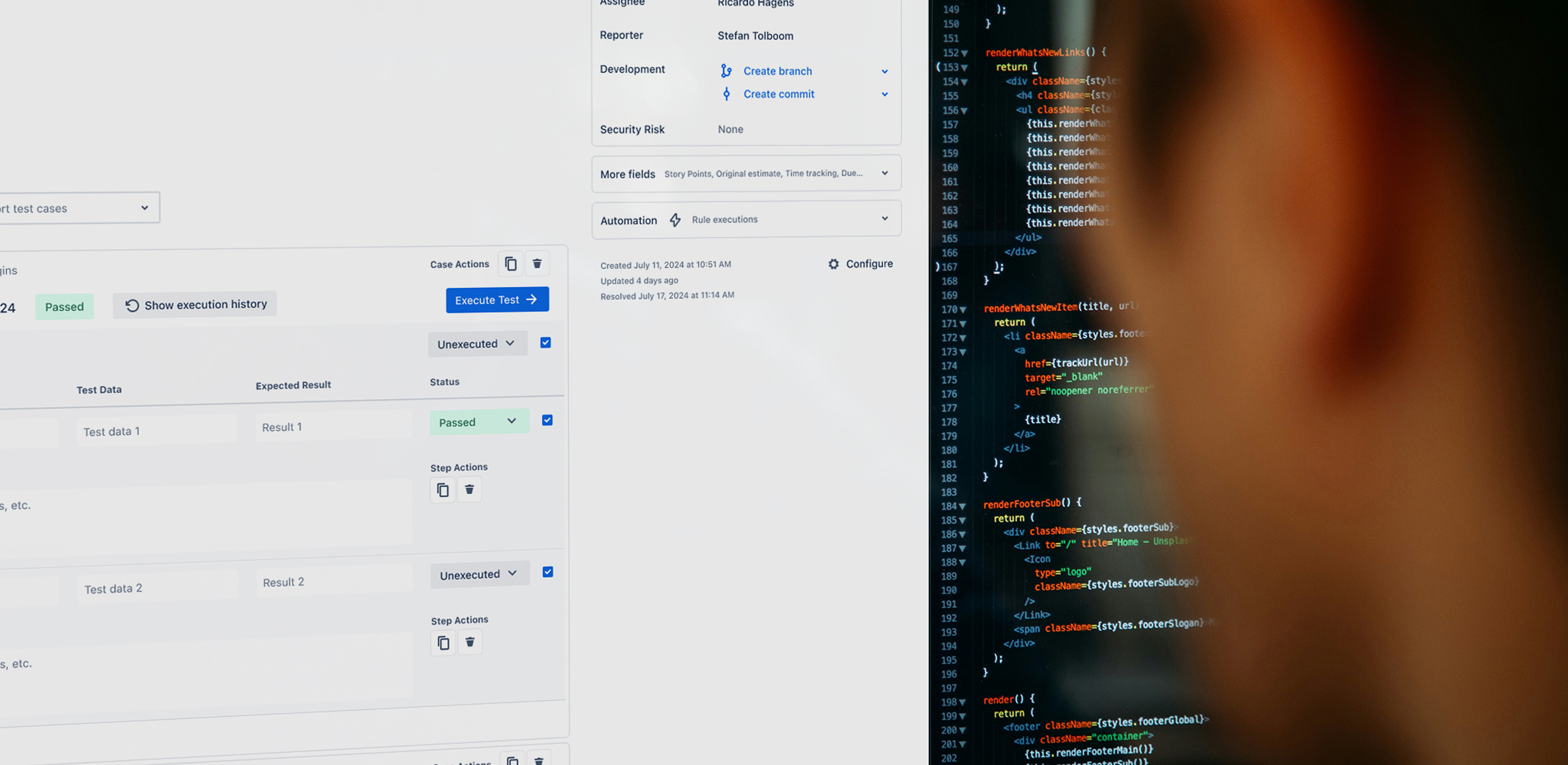
Infodation Test Management System (ITMS) is an application designed for Jira Cloud that provides an all-encompassing view of test work and status across Jira Cloud projects. ITMS streamlines the testing process by offering direct integration with Jira, enabling seamless test case management and execution.
Read more