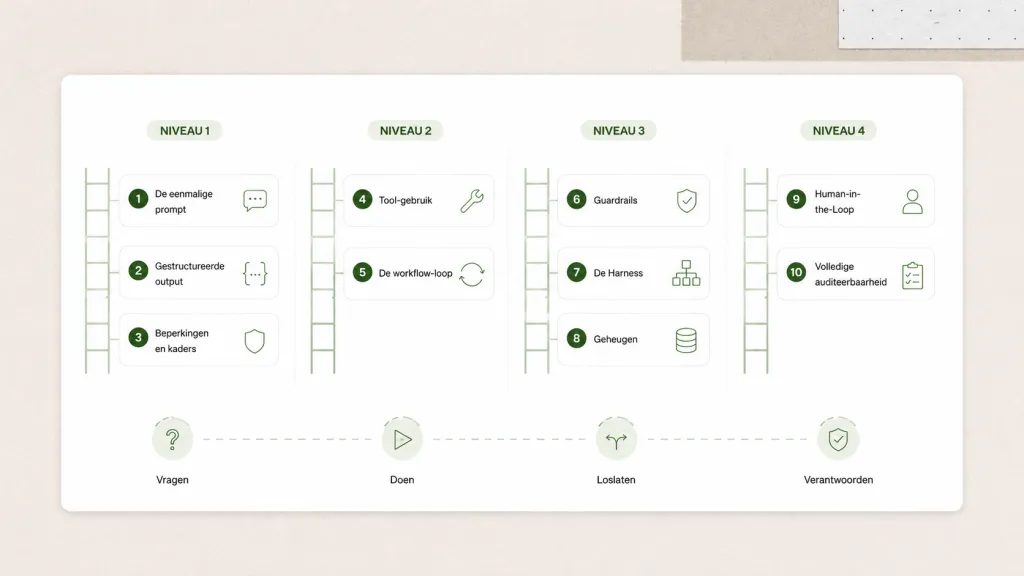
Both call it "AI." Both are right. They are just standing on different rungs of the same ladder. Most of the confusion in engineering rooms comes down to nobody saying out loud which rung they actually mean.
Because the gap between a simple prompt and a full-fledged agent isn't a wall you vault over in one go. It is a ladder you climb, one deliberate rung at a time. And if you climb higher than the task demands, you turn simple problems into needlessly expensive projects.
Here is the ladder. Ten rungs.
Level 1: Still Just Asking
The first three rungs might feel different, but they are essentially the same move wearing different coats. At this stage, you are still asking a question and reading a reply. Formats and rules make the answer better, but they don't make it act. You are still entirely the one driving.
Rung 1: The one-off prompt
This is the purest form. You type in what you want, the AI gives an answer, and the exchange is over.
Rung 2: Structured output
You bring order to it. You ask for a specific structure or shape to fill, like JSON or fixed fields. This ensures the answer arrives in a form you can use immediately, rather than a paragraph you have to unpick yourself.
Rung 3: Constraints and boundaries
You add strict limitations: use only these specific sources, don't guess, stay inside this box. Quality climbs with every step, but the AI is still purely reacting to your command.
Level 2: When Asking Becomes 'Doing'
At the fourth rung, the character of the thing shifts fundamentally. The focus moves from a passive conversation to active execution.
Rung 4: Tool-use
You give the model a tool: a search function, a calculator, or an API it can call. The AI can now fetch real-time information from the outside world and fold that result into its reply. You are still nudging it step-by-step, but for the first time, the AI is reaching outside the chatbox to touch the world.
Rung 5: The workflow loop
You close the loop. Within a single request, the AI can now run through a cycle: plan, act, read what came back, revise its approach, and repeat. The AI stops when the ultimate goal is met, rather than when the first answer lands. The moment a model can run the tests it just wrote, it stops being a "clever colleague" and starts being an unsupervised force.
Level 3: Handing Over the Wheel
A true agent is what you get when you stop specifying the steps and start specifying the outcome. You hand it a goal and some boundaries; the model decides its own next move and navigates until it is done or stuck. Because you have let go of the wheel here, the following rungs are crucial (though they are often skipped in practice).
Rung 6: Guardrails
This is a separate, independent software layer that continuously watches and can veto actions. It blocks unsafe moves and enforces organizational policies at every step, regardless of what the agent has talked itself into.
Rung 7: The Harness (The Scaffolding)
The invisible, unglamorous engineering around the model: managing permissions, tool routing, validation, error handling (retries), logging, and—the most important one everyone forgets—the exact conditions under which the agent must stop.
Rung 8: Memory
The agent is given the ability to retain information. This allows the AI to carry what it learned through the current run, or even across multiple sessions. As a result, the system doesn't have to solve the same problem from scratch every time.
(Note: Rungs 6, 7, and 8 are not the AI model itself. They are the engineering around the model. The clever part was never the hard part).
Level 4: Governance & Accountability
The highest rungs don't make the AI any smarter; instead, they make the system accountable. This is the least exciting part for a product demo, but it is the only level you would actually trust with mission-critical business processes.
Rung 9: Human-in-the-Loop
The system builds in checkpoints that it cannot skip. Whenever the stakes or risks are high enough (such as transferring money or deploying live code), the agent automatically pauses and requests explicit approval from a human operator before proceeding.
Rung 10: Full Auditability (The Top Rung)
The absolute top of the ladder. Every action is logged, every decision is traceable after the fact, and every risky move is heavily gated. Here, the question quietly shifts from "is the answer good?" to "can I prove how this system got there, and do I trust that process?"
A Final Thought
The mistake isn't picking the wrong rung. It is not realizing there is a ladder at all. The result? Organizations reaching for a complex, governed agent system when a tightly constrained prompt (Rung 3) would have done the job. Or, far more dangerously, shipping a loose agent (Rung 5) into a critical production environment without the harness and the audit trail of the top rungs.
Most work in the real world lives much lower on the ladder than the current hype suggests. Know where the truth of your task lives, climb exactly as far as that demands, and stop there.


