De Heus
De Heus is scaling AI-powered invoice processing across Asia
From manual data entry to processing invoices in under 30 seconds: how we helped automate financial workflows and prepare for international expansion.
How can AI make a real difference in everyday business operations?
For De Heus, the answer lies in transforming a time-consuming manual process into a fast, intelligent workflow. By integrating AI-powered invoice scanning into its existing OVS application, Infodation helped De Heus reduce invoice processing time by 7 to 10 times, without disrupting established ways of working. What started as a practical solution in Vietnam is now laying the foundation for international expansion, demonstrating how AI can deliver measurable business impact at scale.

The results in numbers
invoices processed per month on average
for AI-powered invoice data extraction
for invoice processing, including employee review and submission
faster invoice processing compared to the previous manual workflow
in estimated processing time savings reported in De Heus's internal management assessment*
approved in principle for international rollout
*The reported time savings are based on De Heus's internal assessment. The exact calculation period and methodology are pending confirmation.
Reducing manual work in a business-critical process
For an international organisation like De Heus, efficient financial processes are essential to keeping daily operations running smoothly.
In Vietnam, approximately 3,000 sales employees form part of an organisation that handles an average of 10,000 invoices every month.
Employees use the company's existing OVS platform to submit invoices for expenses and payment requests. Previously, this involved uploading an invoice and manually entering the relevant information, including invoice numbers, dates, supplier names, tax codes, addresses and amounts.
Although the process was familiar, it created considerable administrative work. Manual data entry was time-consuming, repetitive and susceptible to errors. Incomplete or incorrect information could also slow down subsequent approval processes.
De Heus wanted to reduce this administrative burden by introducing AI-powered automation. However, replacing the existing application or changing established workflows was not the objective. The challenge was to introduce AI into an existing, continuously operating business system while maintaining accuracy, performance and operational continuity.
Bringing AI directly into existing workflows
Infodation developed and implemented an AI Invoice Scanning solution, fully integrated into De Heus's existing OVS application. The solution automatically extracts relevant information from uploaded invoices and populates the corresponding fields in the application. For employees, the process remains straightforward:
Upload
Upload an invoice in the familiar OVS environment.
AI extraction
The AI automatically extracts and enters the required invoice information.
Review
Review the pre-filled information.
Submit
Submit the invoice for further processing.
The AI extraction itself takes approximately 5–7 seconds. Including employee verification and submission, the process takes less than 30 seconds per invoice.
Employees continue working in the same application, using the same screens and established processes. There is no need to introduce a separate AI application or provide extensive training for a new workflow.
Designed for accuracy, performance and continuity
Introducing AI into an operational business application requires more than connecting an AI model to an existing system. The solution needed to support different invoice layouts, accurately identify relevant information and operate reliably within De Heus's existing IT environment.
Infodation was responsible for the complete delivery, including solution design, AI configuration and optimisation, integration, testing, deployment and ongoing support.
The solution runs within De Heus's Microsoft Azure environment.

During implementation, the team focused on three requirements
1. Accurate extraction across different invoice formats
Invoices vary considerably in layout, structure and the way supplier information is presented.
Infodation optimised the AI solution using real De Heus invoice examples to improve extraction accuracy across these variations.
2. Fast processing without disrupting operations
The existing OVS application supports ongoing business activities and needs to remain available.
The AI integration was designed to deliver fast response times without interrupting established workflows.
3. Operational control and fallback options
The existing manual process remained available alongside the AI functionality. If necessary, the AI component could be disabled within minutes, allowing employees to continue processing invoices manually.
Infodation also provides maintenance and support for alternative AI models. This helps De Heus manage changes in model availability, including situations where a third-party provider retires an existing model.
This approach combines automation with the continuity and control required in operational business environments.
Faster invoice processing and less manual administration
Following implementation, the solution went live in Vietnam and was formally accepted by De Heus. After the first month of use, the De Heus digital team presented the results to management and the Board of Directors. The internal assessment demonstrated a substantial reduction in invoice processing time.
Invoice processing performance
| Metric | Before AI | With AI |
|---|---|---|
| Staff invoice processing | Average 210 seconds | Under 30 seconds |
| Vendor invoice processing | Average 300 seconds | Under 30 seconds |
| AI data extraction | Manual entry | 5–7 seconds |
| Employee workflow | Upload and enter all fields | Upload, review and submit |
Across staff and vendor invoices, the results represent an improvement of approximately 7–10 times in processing speed.
More than 8,000 hours in estimated time savings
De Heus's internal management assessment also compared total processing times before and after the introduction of AI.
| Invoice category | Before AI | With AI | Calculated savings |
|---|---|---|---|
| Staff invoices | 4,605 hours | 657 hours | 3,948 hours |
| Vendor invoices | 4,916 hours | 491 hours | 4,425 hours |
| Total | 9,521 hours | 1,148 hours | 8,373 hours |
The assessment indicates the potential to significantly reduce administrative workload.
The exact measurement period and underlying calculation methodology for these totals have not yet been confirmed.

The benefits extend beyond faster invoice entry
According to De Heus, the project has delivered tangible value in day-to-day operations.
A simpler process
Employees upload, review and submit instead of entering every field by hand, significantly reducing the time spent entering data into the system.
More time for analysis
The solution helps employees move step by step from manual tasks to automation, freeing up more time for in-depth analysis.
Higher accuracy
Automatically populating invoice fields reduces opportunities for manual entry errors and improves operational accuracy, while retaining employee verification before submission.
No new application
De Heus achieved these improvements without replacing its existing application or fundamentally changing how employees work.
The result demonstrates how AI can improve operational efficiency while preserving established processes and maintaining control over business-critical systems.
From promising results to stable, scalable operation
The initial results are encouraging and provide a solid foundation for moving the solution into a phase of stable, efficient and scalable operation. In the next phase, De Heus and Infodation are focusing on two key priorities.
Operational continuity
With an AI service now part of a business-critical process, the workflow needs to run reliably 24/7. This calls for an appropriate Business Continuity Plan, including monitoring and a clear response plan for when the AI service experiences an incident or interruption.
This builds on the safeguards already in place: the manual process remains available, and the AI component can be disabled within minutes.
Financial efficiency of AI
Alongside continuously improving the core AI technology, token costs are tracked as a key metric and need to stay within budget.
This shows whether AI delivers real value in practice and whether its use remains sustainable, including as the solution is rolled out to more countries.
From Vietnam to five additional countries
The successful implementation in Vietnam has created the foundation for a wider international rollout. De Heus has given approval in principle for extending the solution to five additional Asian markets.
- The Philippines
- South Korea
- Cambodia
Implementation activities and User Acceptance Testing (UAT) have already started.
- Myanmar
- India
Progressing through the necessary administrative preparations.
None of these five additional markets was live at the time of the latest project update.
Adapting AI to local requirements
International expansion introduces new challenges. Invoice formats, regulatory requirements and tax information vary between countries, and the needs of De Heus companies across the region are becoming increasingly diverse. A solution that performs well in one market cannot automatically be deployed unchanged in another.
The rollout therefore includes adapting and optimising the AI solution to support local invoice formats and tax requirements. The objective is to build on the technology and experience developed in Vietnam while accommodating country-specific differences.
This allows De Heus to scale a proven approach rather than developing a completely separate solution for every market.
A foundation for broader AI adoption
The invoice scanning project is also opening discussions about a longer-term approach to AI within De Heus. Infodation is exploring the possibility of establishing an AI Center: a centralised approach to developing, maintaining and scaling AI solutions across the organisation. The ambition is to create an environment where AI capabilities can be developed once and adapted for use in multiple countries and business processes.
Potential future opportunities
AI model ownership and flexibility
Exploring alternatives to third-party AI models, including models developed and managed by Infodation, to provide greater flexibility and control.
Workflow optimisation
Identifying additional opportunities to automate repetitive tasks and improve operational efficiency across existing business applications.
Forecasting and decision support
Investigating how AI could support forecasting and decision-making within De Heus's business operations.
Domain-specific AI applications
Exploring opportunities for AI solutions that address challenges specific to animal nutrition and related operational processes.
These initiatives are part of the longer-term vision and have not yet been established as delivered projects.
The broader ambition is to develop a sustainable partnership in which AI solutions support measurable business objectives rather than remaining isolated technology experiments.
Why this project matters
AI delivers its greatest value when it becomes part of everyday business operations. The De Heus project demonstrates that organisations do not necessarily need to replace existing applications or fundamentally redesign established processes to benefit from AI.
By integrating AI into an existing business platform, Infodation helped De Heus address a concrete operational challenge while maintaining the reliability and continuity of its current systems. The solution combines automated data extraction, employee verification, operational safeguards and integration with existing software.
And with expansion into additional countries underway, the initial implementation in Vietnam is becoming the foundation for a broader international approach. With 24/7 continuity and keeping token costs within budget as priorities for the next phase, the focus is on AI that not only works, but remains reliable and affordable at scale. The result is a practical example of moving from AI adoption to measurable business impact.

From AI adoption to AI impact
At Infodation, we help organisations turn AI opportunities into practical, scalable software solutions. By combining software engineering, system integration, architecture and AI expertise, we develop solutions that fit existing business environments and deliver measurable operational value. Whether the challenge involves automating manual processes, modernising existing applications or scaling AI across international operations, we focus on solutions that work in practice.
Looking to integrate AI into your existing business systems?
Let's explore how Infodation can help you turn AI opportunities into measurable results.
Also view:
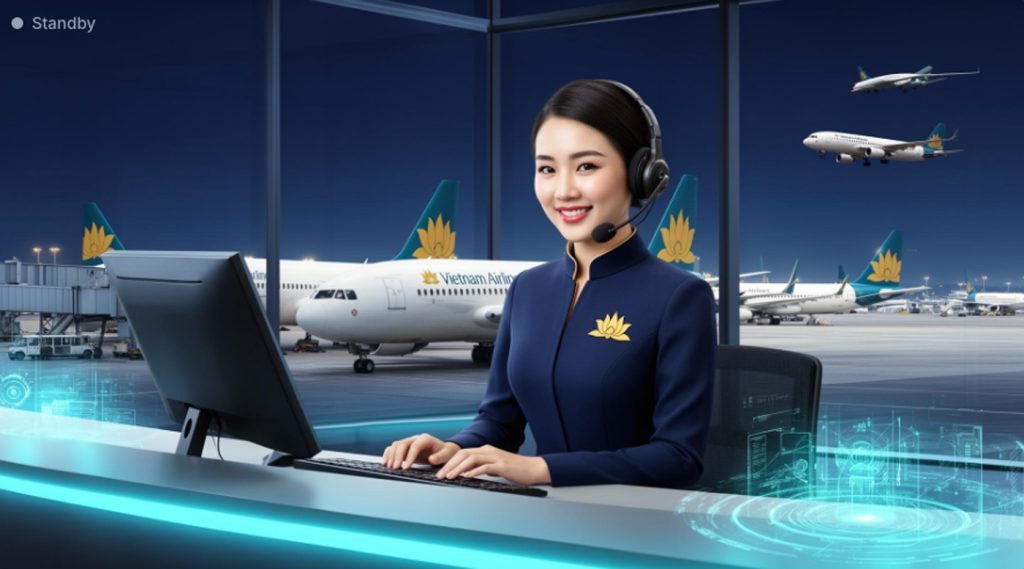
IntelliCall
Transitioning to an AI-Driven Call Center
Vietnam Airlines asked us to rebuild their call center experience from scratch. The result is IntelliCall — a real-time, multilingual AI voice platform that guides customers through intelligent conversations and triggers live actions such as appointment scheduling and call transfers.
Read more