The problem: documentation that falls behind
Documentation is often the first thing to fall behind and the last thing teams want to update. Over time, this leads to missing or outdated documentation, making onboarding harder, slowing down development, and increasing dependency on tribal knowledge. Traditional documentation approaches only make this worse: they are manual, complex, and time-consuming. Our experiment shows that AI can fundamentally change this dynamic. By lowering the effort needed to create and maintain documentation, teams can spend less time maintaining documents and more time on higher-value work such as design decisions, code quality, and collaboration.
The research question
Our goal was to improve software documentation without adding complexity. We focused on two key questions:
How can the C4 model help teams quickly gain a clear overview of a software system? And how can AI support documentation in both new and existing codebases, keeping it accurate and relevant as systems evolve?
The experiment
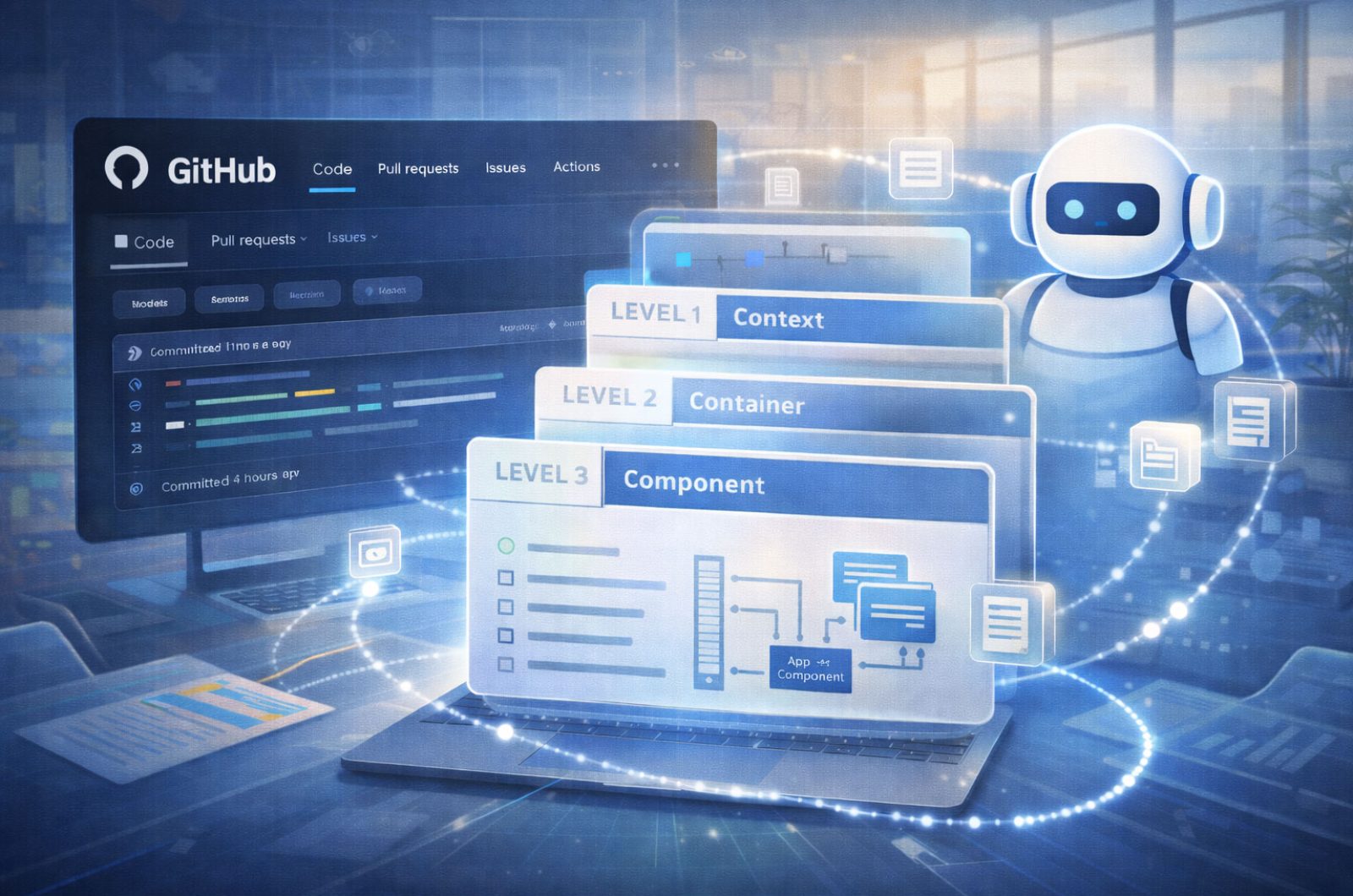
Our R&D team built an AI-supported solution that generates architecture-level documentation directly from a software project’s GitHub repository. Using the C4 model as a structural foundation, the solution analyzes the codebase and produces clear, layered documentation that reflects the actual system architecture.
The approach has already proven its value on our WMS project. Based on these results, development is now focused on expanding the solution to other projects, gathering feedback from teams, and improving usability through a graphical interface. The goal is to make architecture documentation accessible, understandable, and easy to maintain for everyone.
What we discovered
Three insights stood out clearly:
- The C4 model works
Teams using the C4 model benefit from clear and consistent documentation that provides immediate insight into system structure and component relationships. - Onboarding becomes easier
New developers can quickly understand a project by navigating through the different C4 levels, reducing reliance on lengthy handovers or undocumented knowledge. - Documentation becomes dynamic
With AI support, documentation can be updated automatically as the code changes, dramatically reducing the risk of outdated diagrams and descriptions.
What this means for our work
These findings confirm that the C4 model is a highly effective approach to software documentation. It aligns naturally with how developers think and communicate about systems by offering structured views at different levels of abstraction. When combined with AI, documentation evolves from a static artifact into a living system—continuously aligned with the code and the reality of the software.
From static documents to living systems
By combining the C4 model with AI, software documentation becomes a reliable, always-up-to-date source of truth. The effort required to maintain it is drastically reduced, onboarding is accelerated, and teams can focus less on documentation maintenance and more on delivering real value.


